
How to Search the Columbus Court Docket
The city itself publishes no municipal-court docket, ticket database, or court calendar for Columbus. So begin with the court printed on your paperwork. Search through the Nebraska JUSTICE public search. For a Columbus case lookup, County Court is the usual stop. It handles traffic, misdemeanors, infractions, city ordinances, small claims, probate, and juvenile matters. District Court takes the heavier files. Those include felonies, major civil cases, domestic relations, and appeals from County Court.
- Open the JUSTICE search, enable JavaScript, accept its terms, and begin the public search.
- Search using a party name or the case number shown on Columbus paperwork, not the name of a witness.
- Narrow the Columbus result by Platte County, court type, case type, year, or another available field when names are common.
- Open the case detail and read the court, status, current setting, and Register of Actions in sequence.
- Use the calendar and the correct Columbus courthouse clerk to confirm any date that affects an appearance or request.
JUSTICE charges its one-time search fee even when nothing comes back. Results can run to 30 public cases, and access stays open for three calendar days. A brand-new Columbus filing may need about 24 hours to show up. If your case does not appear, slow down. Check the court level first. Then check the name spelling, the case type, restriction status, and whether the file is still on paper. Only then give up on the docket search.
Columbus Court Docket County Seat Route
Columbus anchors the Platte County court-record route. Both County Court and District Court sit in the Platte County Courthouse at 2610 14th Street in Columbus. Both offices are reported on the second floor. Sharing one building does not give the two courts one shared docket. The County Court clerk keeps county-court files. The Clerk of the District Court keeps district-court files.
That split matters before you call or show up. A traffic ticket, infraction, or ordinance case belongs with the County Court office. A felony or major civil file belongs with the District Court office. The statewide register helps a Columbus user find the right court. But certified copies and questions about nonpublic or paper files must go to the clerk who holds that case.
The Platte County history and community page sets the courthouse in its county-seat context. It names Columbus as the county's largest listed city. That civic role is why the Columbus court-record route also serves the other profiled communities.
The Columbus Municipal Court
The City of Columbus posts no separate municipal court docket portal. There is no standalone court counter or dedicated Columbus court schedule either. Its government pages still help with civic context. But they cannot replace a Register of Actions. A Columbus ordinance might name the local rule at issue. Even so, the court printed on the citation governs the search and any record request.
Nebraska's county-court jurisdiction and the city-and-village ordinance filing rule push Columbus ordinance matters into the county-court system. So when the citation points there, search County Court and Platte County in JUSTICE. Skip hunting for a distinct Columbus municipal docket. That only helps if the citation itself names some other court.
For city contacts and civic functions, the official City of Columbus government page is the place to start. It cannot create a separate source for a Columbus individual court case. It cannot supply a court date or certified court document either. The official page lists government offices and services for the city.
That Columbus civic page helps draw the line. City administration sits on one side, and the County Court docket path that governs the actual court record sits on the other.
Columbus Court Records at the Courthouse
A paid public search is not the only route to Columbus court records. The public-access design includes courthouse terminals. Court rules allow electronic inspection at a clerk terminal or at the Nebraska State Library where the material is available. Platte's webpages never name a terminal room. So ask the clerk rather than assume a terminal waits in some particular room.
County Court lists a Columbus phone of 402-563-4905, and District Court lists 402-563-4906. Have the case number, caption, court, case type, and the entry or date in question ready. Make those ready before you call. For local functions and contacts, see County Court and District Court.
Columbus County Court route
Platte County Courthouse, 2610 14th Street, second floor
County Court clerk: 402-563-4905
Use for traffic, infractions, ordinance, misdemeanor, small-claims, probate, and county juvenile matters.
Columbus District Court route
Platte County Courthouse, 2610 14th Street, second floor
District Court clerk: 402-563-4906
Use for felony, major civil, domestic-relations, and related district matters.
Copy requests by mail, fax, email, or in person depend on the clerk and the request form. The public portal can locate a Columbus file. It cannot certify the record.
Columbus Court Dates and Settings
The case register may show a Columbus court date. Nebraska also runs a separate statewide calendar search. Select County Court or District Court, select Platte, then search by a current or future date or by last name. Don't confuse that calendar with the JUSTICE case search. They answer different questions. A blank Columbus calendar response is not proof that no setting exists, since entries can lag. Before relying on an older Columbus notice, read the newest register entry. A filing is a request, not a ruling. A setting does not prove a hearing occurred, and a continued or reset event can replace an earlier date. When the date affects an appearance, a payment decision, or a record request, call the Columbus clerk.
| Date | The listed Columbus setting date; check the newest register event for changes. |
|---|---|
| Time | The published time for the setting or docket call, if the calendar shows one. |
| Location | The court location or courtroom shown in the calendar or case detail. |
| Court | County Court or District Court, which determines the Columbus clerk to contact. |
| Setting type | The event label, such as hearing, arraignment, trial, or another scheduled court action. |
The official Nebraska court calendar lets you pick the court and the county a Columbus search needs. Use it next to the Register of Actions, never in place of it.
Columbus JUSTICE Court Record Details
Open a Columbus case detail and you can see plenty. The view covers the case number, court, caption or parties, case type, status, offense information in criminal matters, financial information, the Register of Actions, and any document images. The calendar adds a date, time, location, and event type. These are separate layers of a Columbus court record, and each answers a different question.
Read the register in order, oldest entry first. Keep the current setting apart from the final judgment or disposition. A charge line alone does not establish a conviction. A cost assessment does not prove payment. Document images for nonconfidential filings made or uploaded after April 16, 2008 may be available. A missing Columbus image can mean restriction, paper status, delay, or a coverage boundary.
- Register of Actions
- The dated Columbus case activity record, including filings, hearings, orders, and other events.
- Disposition
- The case outcome or closing action shown by the judgment, dismissal, plea, or another final order.
- Certified copy
- A clerk-authenticated record. A visible Columbus document image is not automatically certified.
JUSTICE uses public case-information terms rather than a published Platte-specific code dictionary. Build a Columbus case number from a prefix guess and you will likely miss. Copy it exactly from the result or the clerk paperwork.
Columbus Traffic Tickets
For a Columbus traffic ticket, start with the court printed on the citation. Then search County Court and Platte County if that is the named venue. Traffic, infraction, and municipal-ordinance matters follow the County Court route. Columbus offers no official citation lookup, ticket-payment page, or city traffic calendar. The citation itself and the statewide county search are the defensible starting points.
A payment entry is not always the final outcome. Paying online may not be appropriate if the citation requires an appearance. So check the current Columbus setting and the register first. For more on citations countywide, see the Platte County traffic court records page. A Columbus police involvement or a Columbus ordinance does not create a separate Columbus docket. Keep the citation number and court name. Then verify through the Register of Actions or the County Court clerk.
Columbus Court Docket Program Context
Columbus court records can hold more than a routine traffic or civil setting. The Nebraska Judicial Branch announced in July 2024 a District 5 milestone. District 5 opened its first Platte County problem-solving court in Columbus. A January 2026 announcement then reported the program's first graduation. The Platte program is an Adult Drug Court. Those milestones describe the system, not any one case file.
The official program-opening announcement documents the Columbus launch. To learn what a particular file actually shows, use the court and the case number. The Register of Actions carries the rest. A program announcement will not identify a current setting, a restriction, or a disposition.
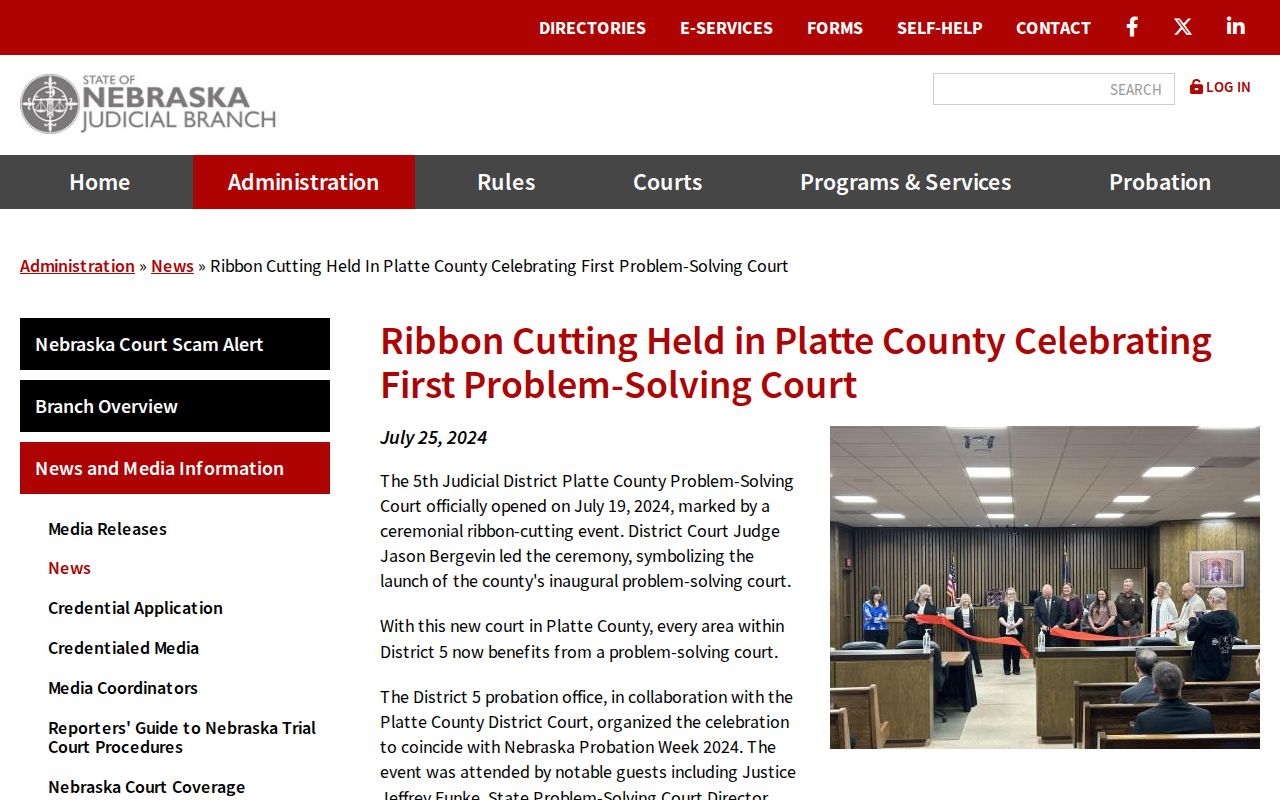
A documented District 5 milestone and everyday Columbus court access belong to two different tasks. One explains the system. The other keeps docket interpretation with the official case record.
Where Columbus Cases End Up
Columbus cases do not pass through a city-court database before reaching the county system. The route starts with the venue printed on the citation or the filing. County Court keeps the countywide docket for many Columbus traffic, misdemeanor, infraction, ordinance, probate, limited-civil, small-claims, and juvenile matters. District Court holds the Columbus felony, major civil, domestic-relations, and related district cases.
Docket flow: Columbus city matter › Platte County Court or District Court › Nebraska Court of Appeals, with final appellate authority in the Nebraska Supreme Court where review proceeds that far.
The Columbus label tells you where an event arose, not which database controls it. Look instead at the court and county fields in the case detail; that is where the docket lives. A federal Columbus matter sits outside JUSTICE entirely and follows the federal PACER and clerk route instead.
Columbus Court Docket Public Milestones
News about a Columbus court program can explain a public development. It does not reveal anyone's case record. The Nebraska Judicial Branch's first-graduation announcement marks a January 2026 milestone. That milestone belongs to the Platte County problem-solving court. Read it as institutional context. It is not a tool for researching a personal case.
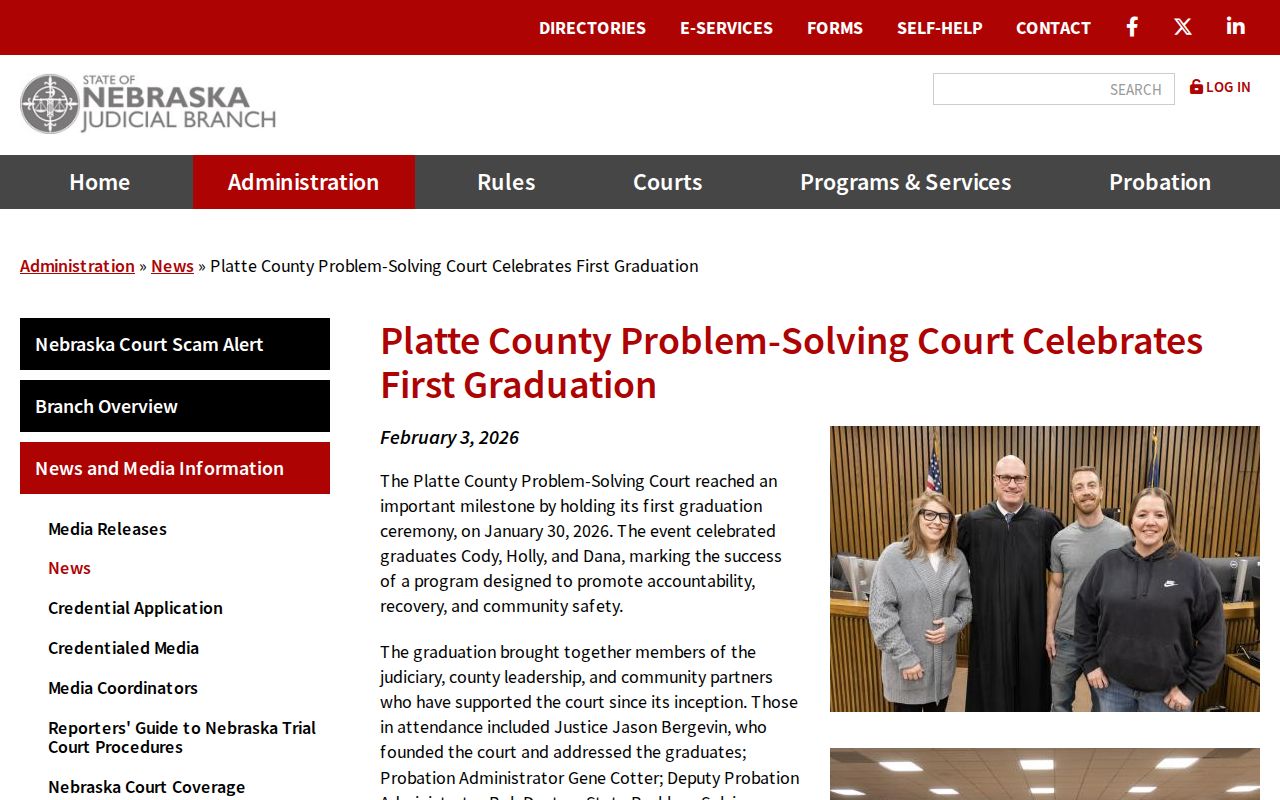
The graduation announcement shows why official news and the Register of Actions serve different purposes. One describes a program milestone. The other records one court case.
When a Columbus record mentions a program, read the orders and the current register entries first. Draw conclusions after that. No public notice, payment record, or calendar entry alone can stand in for the full procedural history.
Public Access to Columbus Court Records
Nebraska court rules and public-record law decide who may see a Columbus court record. No city policy of Columbus itself controls that. The path is simple in outline. First figure out whether the case sits in County Court or District Court. Then search JUSTICE and read the register of actions. Ask the right office for a certified document when one is needed. One caution: a record can be public yet carry no online image. Even a public image is not the same thing as a clerk-certified copy. So ask the clerk when the paper matters.
Key Rules:
Neb. Rev. Stat. § 84-712 permits examination of public records and personal notes or copies during office hours, subject to the law’s limits and custodian copy fees.
Nebraska Supreme Court Rule § 2-215 makes filings public unless a law, rule, or order restricts them and allows electronic inspection at specified public locations.
Nebraska Judicial Branch Article 8 describes public court-case information, remote access, terminals, and limits that apply to public court data.
Not everything in a Columbus court file is open. Some material is simply limited. Juvenile content, sealed records, and protected identifiers fall in that group, along with undigitized paper. Records destroyed under a retention schedule may be gone. Nebraska’s redaction rule also bars certain personal identifiers from public criminal filings. A search that returns nothing does not prove a Columbus case never existed. And a clerk cannot certify a search of a record that has already been destroyed.
Columbus Court Docket Access Limits
Know the limits before you travel or file a request. JUSTICE public search caps results at 30 cases. A common name has to be narrowed down. The one-time search works only inside a three-day window. A brand-new Columbus filing may lag before it shows up in the system. The online record never replaces a certified copy from the clerk. Subscriber search adds broader filters, but its case detail carries a different fee structure plus account requirements.
Law sets limits too. Juvenile, sealed, restricted, protected, and other sensitive material may simply be unavailable from a distance. A register line can exist even when no image does. Use the clerk’s authorized release process when a file is sealed. A blank in public search is not permission to obtain the record some other way.
When a Columbus setting looks wrong or a case fails to appear, work the checklist. Compare the court and county fields. Allow for entry lag and search the calendar separately. Then call the correct clerk. That order keeps the Columbus docket search pointed at the court that actually holds the case.